Posted on

The most important parameter when tamping: The pressure distribution

The previous blog post discussed tamping pressure. We learned that the absolute pressure is almost irrelevant as long as it remains consistent from shot to shot. The firstshot tamper and other dynamometric tampers guarantee this through a pressure regulation system. With the firstshot tamper, the pressure can be adjusted to personal taste or preference by changing the spring. If the pressure is of lesser importance, what is crucial when tamping? What determines whether the espresso flows evenly or is subject to channeling from the bottomless portafilter?

The answer is simple: it depends on the pressure distribution during tamping. The pressure distribution during tamping influences the density distribution of the coffee puck. If the pressure is greater on one side of the coffee puck than the other, it will be more compressed on that side. This results in a coffee puck with uneven density. When the water in the machine then encounters the espresso puck, it simply takes the path of least resistance and flows through the coffee puck unevenly. The water distributes itself evenly at a constant pressure in the portafilter, but flows more esily through the less compressed part of the coffee puck. In the best-case scenario, some of the espresso grounds are over-extracted, while another part barely passes through and is therefore under-extracted. In the worst-case scenario, the water creates a channel in the less compressed coffee grounds and flows unimpeded through this channel, bypassing the coffee grounds – a phenomenon known as channeling. This is visualized in the following diagrams (Figs. 1-3).

Fig. 1: Uniform flow rate with a uniformly compressed espresso puck

Fig. 2: Uneven flow rate due to uneven pressure distribution during tamping

Fig. 3: Channeling due to uneven pressure distribution during tamping

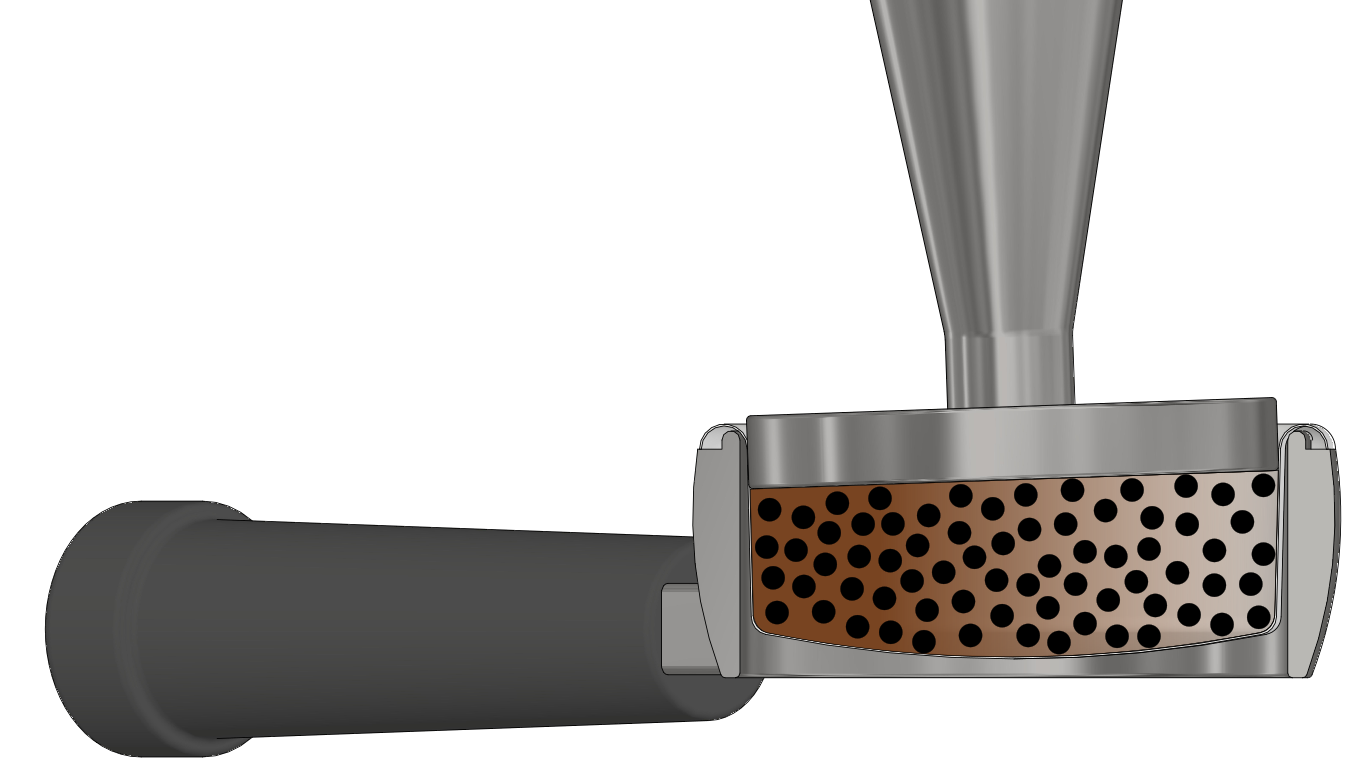
But how does uneven pressure distribution occur during tamping, and how can it be effectively prevented? The most important cause is tilting the tamper base during tamping. This is illustrated in Figures 4 and 5. To prevent this, there are various recommendations regarding hand and arm positioning, as well as visual or tactile control of the tamper base's alignment with the portafilter basket's edge, for example, by placing the fingertips on the basket's rim. These approaches require a great deal of practice to master and remain quite prone to error. The firstshot tamper offers a much simpler and more precise solution. It features a mechanism that attaches to the portafilter and guides the tamper base precisely during tamping. Furthermore, the spherical handle decouples the tamper's movement from the hand position. This guarantees 100% level tamping and ensures even compaction of the espresso grounds.

Fig. 4: Even pressure distribution during tamping

Fig. 5: Uneven pressure distribution during tamping

A second cause of uneven pressure distribution when tamping is the use of a tamper that is too small for the portafilter basket. Some tampers have a smaller diameter compared to the basket. This creates a gap at the edge between the tamper base and the basket, where no pressure is applied to the espresso grounds. This can lead to the espresso puck not being properly compressed at the edges. The base of the firstshot tamper, at 58.4 mm, is slightly larger than the nominal size of a 58 mm basket. This minimizes the gap around the edge in most baskets and results in more even compaction at the edges. While ensuring compatibility with most baskets.

The third reason lies in the even distribution of the espresso grounds before tamping. These effects will be discussed in a separate blog post.

More information on the firstshot tamper and visit the firstshot tamper in the shop!
Posted on

The correct pressure when tamping

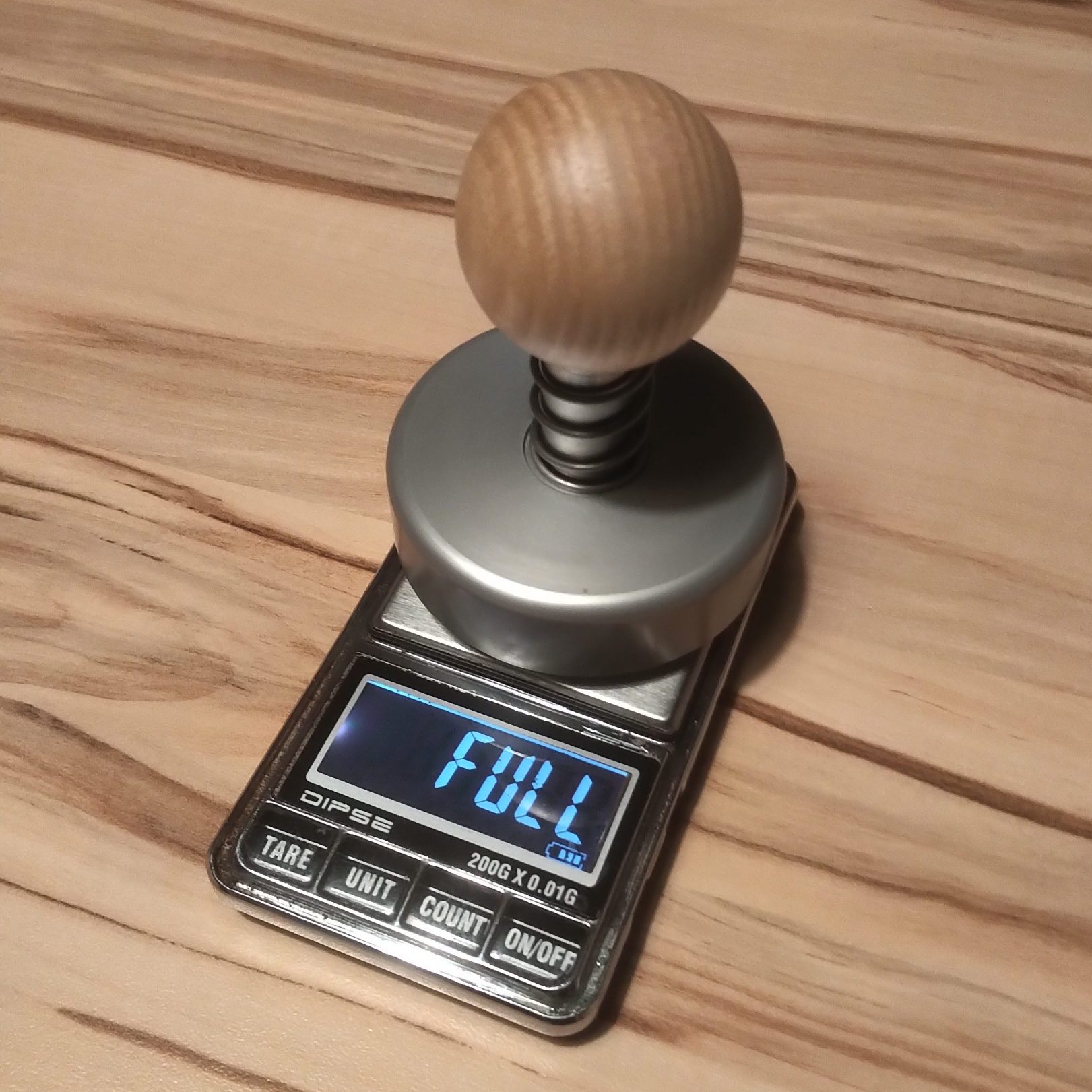
The correct force – or more precisely, the correct pressure (force per unit area) – when tamping is a frequently and controversially discussed topic. We are familiar with the image of the barista who firmly compresses the espresso grounds with a heavy coffee tamper and a slightly angled arm. However, anyone who visits an espresso bar in southern europe will often see that the barista doesn't use a tamper at all, but simply presses the portafilter with minimal force against an arm attached to the grinder. This already gives a sense of the range of pressure required for tamping. Internet forums and tutorials often mention specific pressure values, frequently combined with the recommendation to check your tamping pressure using scales and to practice repeated tamping with consistent pressure. For intuitive understanding, it has become standard practice not to specify force in Newtons (N) or pressure in Pascals (Pa), but rather to state the mass that would exert the equivalent force when placed on the tamper. This is precisely the value that can be read on the indicator when practicing with scales. Typical recommendations range from 5 to 20 kg, but higher values ​​exceeding 25 kg are also mentioned. However, at the upper end of this range, the limit of what an average person can achieve with a tamper at work surface height is quickly reached.

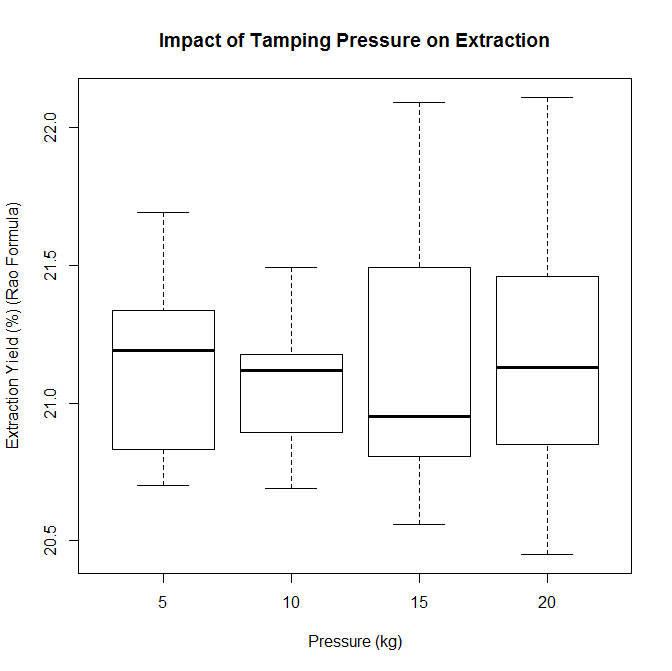
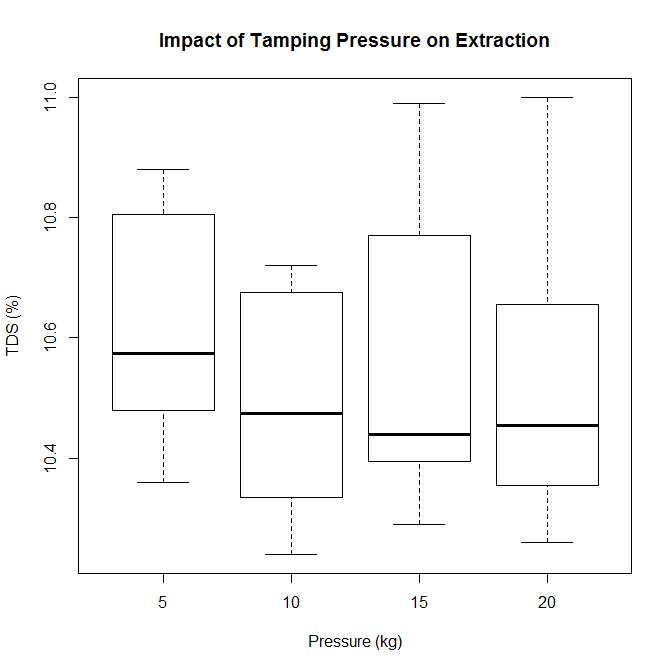
But what is correct? Who is right? Gentle tamping or forceful compression? The blog Socratic Coffee approached this question using scientific methods and, in this study examined the extraction quality in relation to tamping pressure. For this purpose, espresso was prepared with different pressures (5, 10, 15, and 20 kg), but with otherwise constant and closely controlled parameters. For valid results, 10 shots were evaluated for each of the four pressures. To assess the extraction quality, the total dissolved solids (TDS) were measured for each of the 40 espressi using a refractometer and the degree of extraction was determined. Because that is precisely what coffee extraction is about: extracting the flavor-carrying substances, such as sugars and acids, from the coffee grounds. Accordingly, the TDS in the espresso can be used as a quantifiable measure of extraction quantity. The results of the study are presented below (Source: Socratic Coffee).

In fact, the study shows no significant influence of tamping pressure on the dissolved solids in the espresso or the extraction rate. This result is confirmed in a similar study by Tomonori & Smrke for tamping pressures above 5 kg, as well as in a video by Kaffeemacher Accordingly, it can be concluded that all tamping pressures within the typically recommended range of 5-20 kg are valid and suitable for espresso extraction. Within this range, there is no clear right or wrong. So, does tamping pressure not matter? If so, why use a dynamometric tamper with pressure regulation at all?

Measuring the total dissolved solids (TDS) only indicates how many solids are dissolved in the water, not which ones or in what composition. Therefore, the results do not rule out the possibility that different tamping pressures, especially in combination with other parameters such as grind size, lead to different flavor profiles. For this reason, the tamping pressure of the firstshot tamper can be adjusted within the relevant range by changing the spring. This allows each customer to experiment with the tamping pressure and adapt it to their personal preferences or habits. Above the range of 5 to 20 kg considered in the aforementioned studies, pressure does indeed have an influence. Experiments using – admittedly – ​​less scientific methods have been documented by the Hydraulic Press Channel in this video In these experiments, the coffee puck was compressed with up to 1000 kg of pressure.

Besides the fact that it's not yet definitively clear whether tamping pressure affects the flavor profile of espresso, it's essential in espresso preparation to control all influencing factors as precisely and consistently as possible. This forms the basis for selectively manipulating individual parameters, such as the grind size or tamping pressure, and clearly attributing the resulting change in taste to its cause. If the parameters fluctuate unintentionally, it's impossible to determine whether a change in taste is due to, for example, a change in the grind size or a random fluctuation in tamping pressure. The foundation for any optimization is missing. Furthermore, consistency and repeatability in the preparation parameters lead to consistency and repeatability in coffee quality. Once the perfect parameters are found, the result can be replicated. Changes, for example, due to bean aging, can be immediately identified and corrected by targeted parameter adjustments, without having to first establish a trend over several fluctuating brews. This is particularly important for those who only drink two or three espressos in the morning before work.

The firstshot tamper, with its sophisticated dynamometric system and precise haptic feedback, guarantees a consistently uniform and repeatable tamping pressure, thus providing an essential foundation for consistently high-quality espresso. Even more important than repeated tamping with consistent pressure is the even pressure distribution within the espresso puck. Learn more about this and how the firstshot tamper helps in the next blog post.

More information on the firstshot tamper and visit the firstshot tamper in the shop!
Another worthwhile article on investigations into the density of the espresso puck: Improved Puck Density Measurement